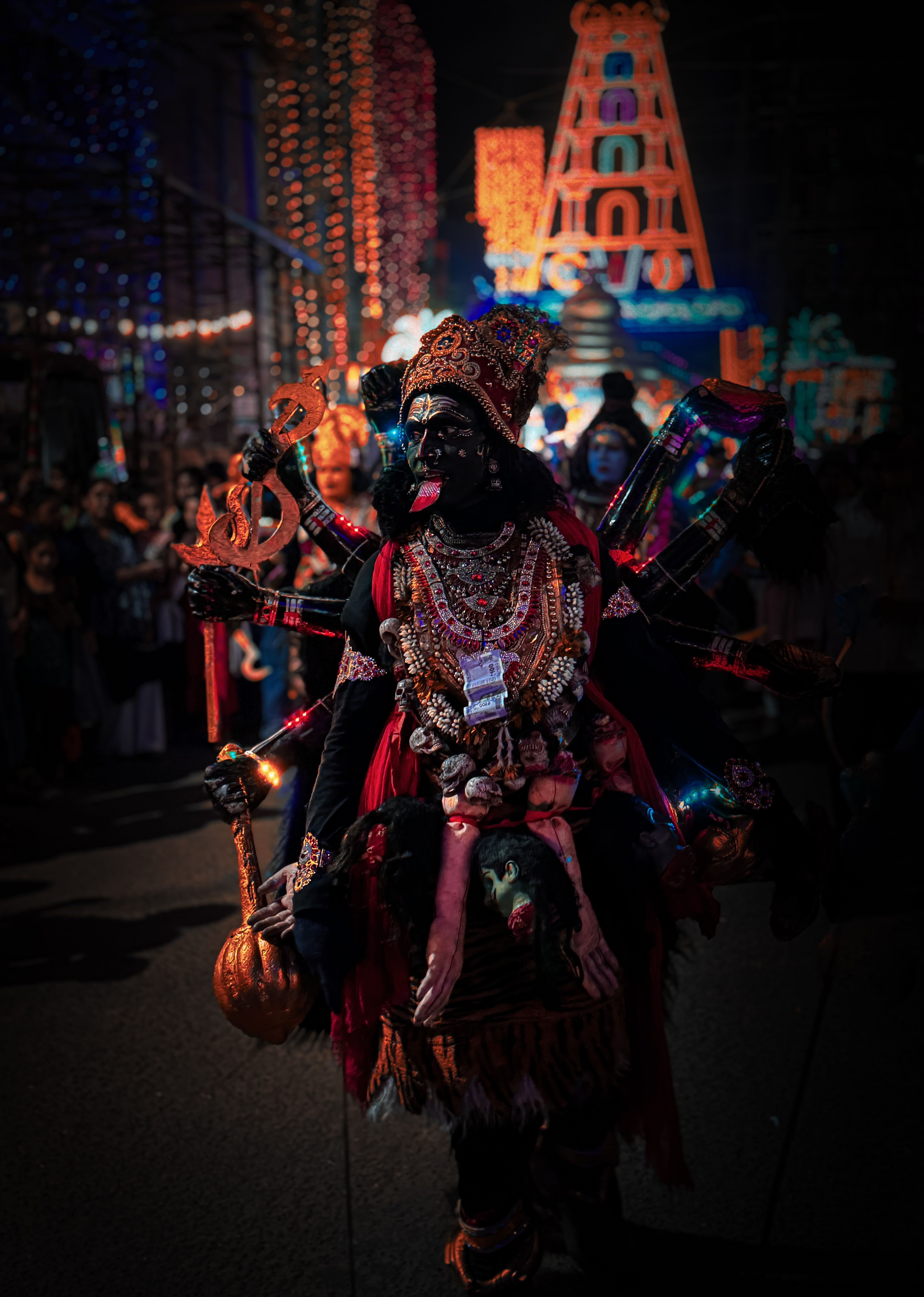
The son of God, Jesus Christ declared, “If someone strikes you on the right cheek, turn the other also.” Our own Gods say something different: “If someone strikes you on the right cheek, return the slap.” Yet the same Gods and the Shastram uphold Ahimsa as the highest means for human evolution. Krishna declares in the Gita, अहिंसा सत्यमक्रोधस्त्यागः शान्तिरपैशुनम्, Ahimsa towards all beings.
Our Gods are embodiments of Ahimsa, yet they carry weapons capable of annihilating the universe. Is this a contradiction? There is no contradiction. Only our misunderstanding. We must not confuse Ahimsa with non violence. Krishna upheld Ahimsa yet ensured the destruction of the Kauravas for the sake of Dharma. Rama, the ocean of compassion, took up arms and annihilated Ravana’s army. How do we understand this?
Ahimsa is not about inaction. If a dog charges to bite you, you may pick up a stone to protect yourself. This is not violence. But if you pick up a stone and go searching for a dog to throw it at, the same act becomes Himsa or violence. Action is not the problem. The attitude behind the action is the truth of Ahimsa.
Life places us in situations where we must act. Shastram never recommends inaction. Action aligned with Dharma is Ahimsa. Action aligned with Adharma becomes Himsa. Sometimes you may walk away from conflict to allow time and space. But there are moments when not acting becomes a violation of your Svadharma. Krishna himself lifted a weapon to strike Bhishma because Arjuna was not fighting with the right spirit. Inaction would have been Adharma.
How should one act? If you must slap, you slap. But inside, you are not burning. You are smiling. You remain a witness to your own action. Once the action is done, no residue remains. There is no guilt, no pride, no satisfaction. The witness is untouched by action and its result. This is Ahimsa.
Do you remember the four traditional ancient strategies in conflict resolution? Sama, Dana, Bheda and Dhanda? Sama is the first movement, the way of peace, dialogue, negotiation, and gentle persuasion. One begins with harmony. If the initial approach does not resolve the situation, one tries Dana, offering concessions and creating space for understanding. If this still does not bring alignment, one moves to the third step, Bheda. Bheda is about discerning the inner weakness of the situation or individual and addressing it from within. And if none of these approaches succeed, one finally takes up Danda. Danda is the application of authority, discipline, or even physical force when required.
In Sama, Dana, Bheda, and Danda, every action is anchored in Dharma. The person established in Ahimsa acts with an inner smile, remaining a witness to their own actions. There is no inner violence, even when outer firmness is required. Ahimsa is not merely non violence. It is the very nature of the divine, just as heat is the nature of fire. Fire can warm or burn. Both are possible. Yet fire never ceases to be fire. In the same way, the one rooted in Ahimsa remains untouched within, irrespective of the action expressed outside.
In our culture, the word Sadhu carries different meanings depending on the context in which it is used. A Sadhu can refer to a sannyasi, a renunciate. It can also refer to a person who simply keeps away from action. We say, “He is a Sadhu, he never gets angry, never reacts, never fights. On the surface, this may appear noble. It may even look like the mark of a sattvic mind. But we often confuse a tamasic person with a sattvic one. A tamasic person withdraws out of laziness, dullness, or indifference. It is a mind covered by inertia, sleep, and ignorance. A Yogi with a sattvic mind also avoids unnecessary confrontation but for a completely different reason. He remains balanced in every situation. He acts when the situation demands, and he acts from freedom, not from compulsion. His actions arise effortlessly, with a smile. He is engaged in action, yet untouched by action. He remains the witness, the Sakshi. This is about clarity and inner mastery.
In Tamil, there is a saying: “Sadhu mirandal kaadu kolladhu.” It means – If the gentle one, the saintly one, becomes angry, even the forest cannot contain the force of that anger. Such anger is like the anger of Rishi Durvasa, an enlightened being overflowing with compassion. Outwardly, his anger blazes like a consuming fire, capable of destroying anything before him. Inwardly, that very fire becomes the cool radiance of a full moon. The outer expression is fierce, and the inner state is untouched, serene.
A Naga Sādhu lives away from the noise and disturbances of society. The world does not distract him. He teaches Ahimsa. Yet, if the situation demands, he will stand at the very front with weapons in hand to protect Dharma. His outer fierceness arises only from inner stillness. His strength is an expression of compassion, not violence. This is the paradox of the ascetic, silent like the sky, but capable of thunder when Dharma calls.
In the same way, your actions must never disturb you. Your anger must not burn you. You must remain soaked in compassion and happiness, whatever action arises. When a teacher shouts at a student, the teacher is not troubled. The shout is not born from agitation. It is born from clarity. It corrects the student, aligns him, helps him. This is the nature of true strength, fierce outside when needed, cool inside always.
Act when you must. Ensure that your actions adhere to Dharma. Remain a witness to your own movements. Let your actions arise from your centre, not from the restless periphery of mind and senses. If action arises from the centre, it is Ahimsa. If it arises from the periphery of mind and senses, it is reaction. Reaction is Himsa.
Now you understand why our Gods carry weapons. They are the embodiment of Ahimsa, like fire, whose nature is heat. Fire can warm or burn. Yet fire remains fire, untouched by its own actions. Ahimsa is the nature of the divine. Let it be your nature.

