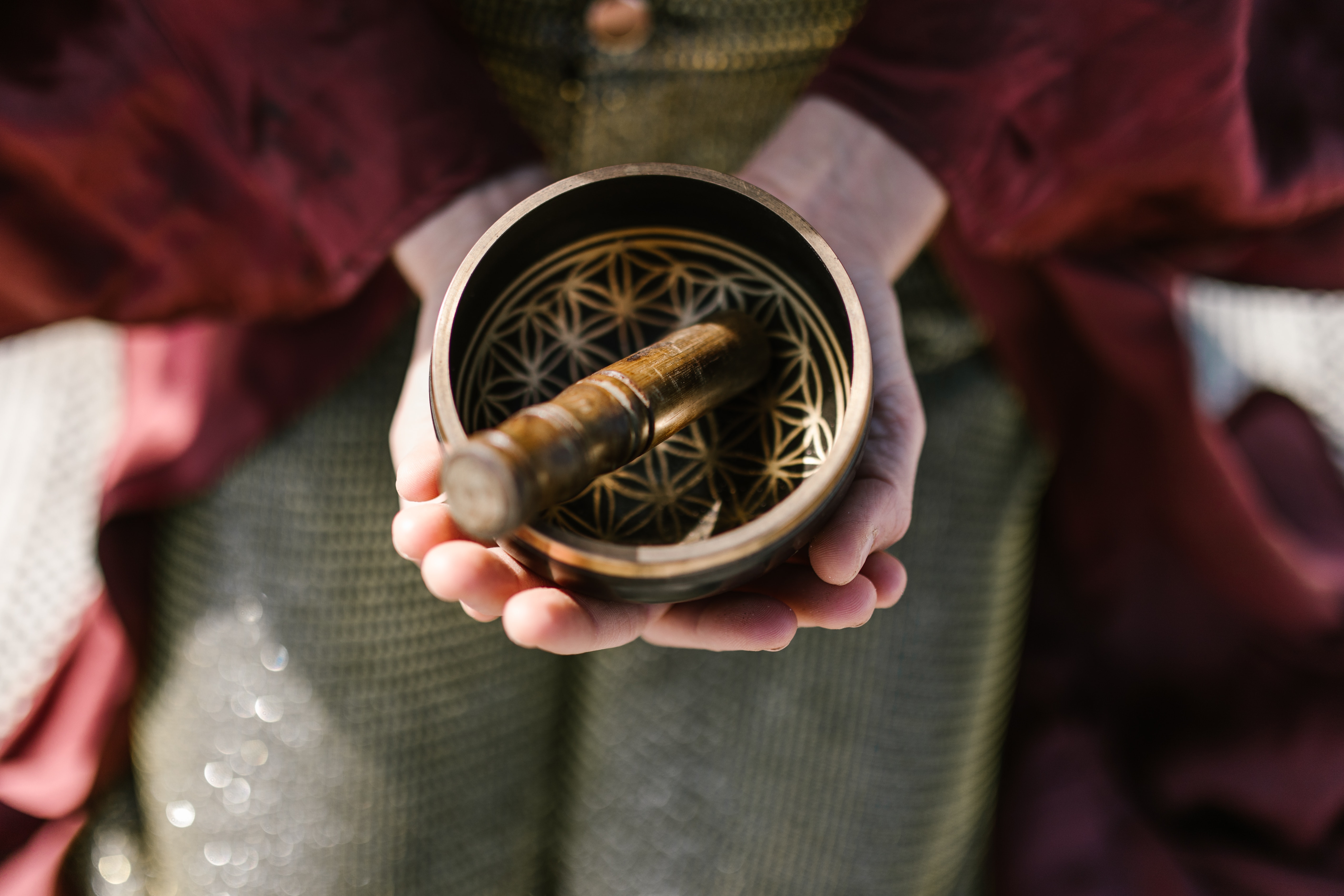
 Parivraajaka (पारिव्राजक) translates to a wanderer. Parivraajaka is masculine form. Parivrājikā (परिव्राजिका) is the feminine form. They typically refer to either monks or nuns. It is said that throughout history, there have been a small number of them. The examples are Buddha, Mahavira and few others. There are equal number of women ascetics, the Parivrājikā. They wander all over and give spiritual instructions. There is an Upanishad called Paramahamsa Parivraajaka Upanishad that discusses this topic extensively.
We can also call ourselves as Parivraajaka or Parivrājikā. Even though we do not physically and extensively travel like a Parivraajaka, we are experts in undertaking time travel with our minds. Our minds constantly travel between the past and future. This time travel comes naturally to us, and we can do it at will. However, our travels do not have the purpose of a Parivrājikā.
I heard that an astrologer had once predicted that I will not have affinity to settle down in one place. I will constantly travel. To prove his point, he had pointed out to some lines under my feet resembling a wheel. Even though I am sceptical about the quality of today’s astrological science, his prediction became true to some extent.
To honour his predication, let me call myself for once a Parivraajaka. During my wandering, I have met and mingled with varieties of human beings. It is a long list, as I am talking about a time spanning more than twenty years. This indicative list includes Indians, Pakistanis, Bangladeshis, North American, South American, African, Europeans, Chinese, Tibetans, Mongolian, Arabs among others. Yet another dimension to this list includes Hindus, Catholics, Protestants, Sufis, Sunni Muslims, Native Americans or Red Indians, the Sami tribe near North Pole, the Siberian Shamans etc.
This raised a question in me. Are human beings remarkably similar despite the many variations ranging from size, skin colour, shape, eyes, geographical location, culture etc.? Even though we belong to the same species, do we really believe we are similar? I was searching for an answer until the time the word ‘expression’ stuck me.
Humans have the power to express in many ways. We can express ourselves as artists, vocalists, painters, poets, scientists and so on. Animals do not have this power of expression. What influences our power of expression?
The society in which we live largely influences our expression. We are conditioned by the society in which we live . We are born in a particular geographical environment and includes a body type, a skin type, eye colour, a language, belief systems, preferences, and practices. Our expression happens through this conditioning and hence cannot be termed as pure. It is like a white light traveling through a prism and appearing as many colours. The whiteness is lost in the multitude of colours.
Our bodies and minds are conditioned by the society in which we live. This becomes our world. This also becomes the cause for divisions giving rise to superior and inferior notions, comparisons, individualism, and conflicts including religious conflicts.
Now, look at the child born in every society. What conditioning does the child have at the time of birth? Every child is like a seed. The future of the seed in terms of how it sprouts, grows and flowers, is entirely determined by the society. The child has lost its independence and forced to develop a personality based on the conditioning. This becomes the truth for many and foundation for human conflict and suffering.
Let me go back to my question. Are human beings remarkably similar despite the many variations? The answer is yes at the time when we are born. This remarkable similarity is forgotten as we grow, and the society takes over our lives. It is just a matter of turning back and recognising this similarity and oneness. It will be a beautiful world and our expressions will be pure. A lot of us can become Buddha, Mahavira, and many more.
 baladrishti
In this article there is a hidden secret that makes one think of.. The unexpressed expressions, un-noticed by many. Only a true explorer can sensitively grasp it. 🙏
LikeLike
Absolutely true.
LikeLike