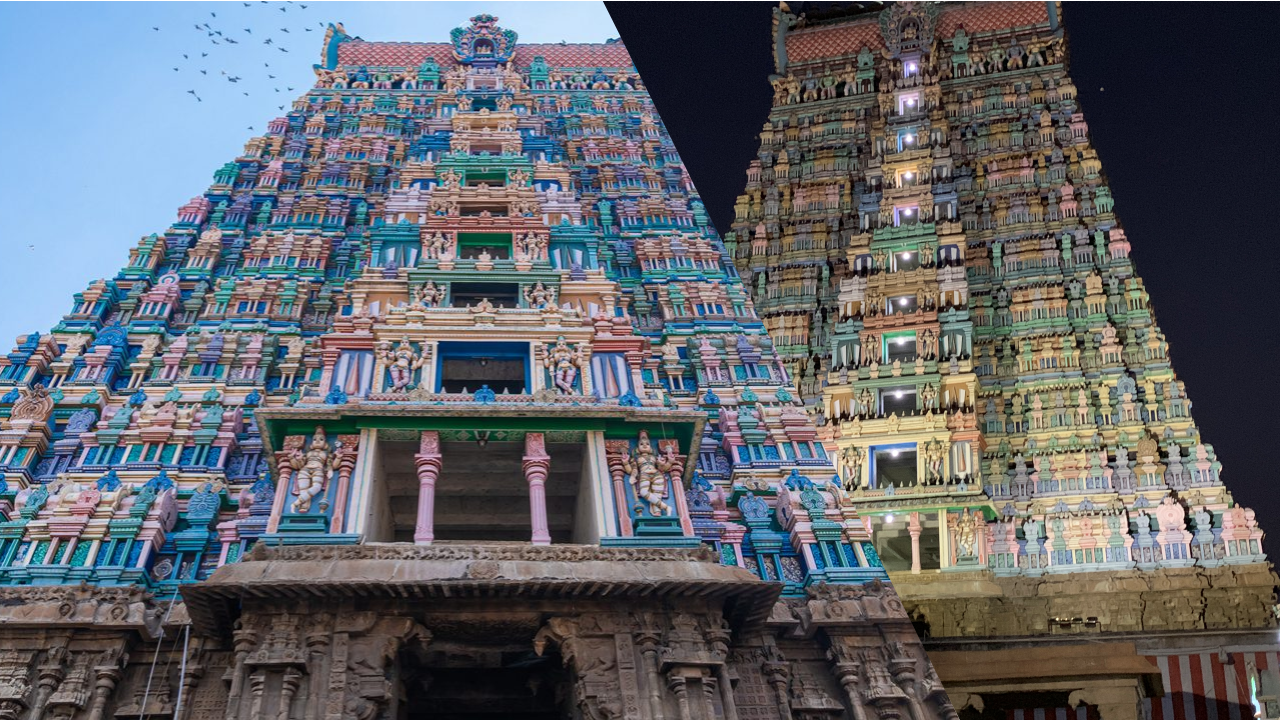
Dhanur Masam arrives wrapped in chill, a season when the body seeks refuge in warmth. Blankets become fortresses, and sleep stretches itself into the morning as though promising a taste of eternity. In those lingering hours, laziness feels like a gift, a fleeting happiness that tempts us to believe we have found rest.
Yet tradition speaks differently. To rise before dawn, when the air bites and the sky is still dark, is to step beyond the comfort of the senses. It is to pierce through inertia and awaken to the subtle presence of divinity. The pre-dawn hours are not simply time; they are a threshold, a sacred silence where surrender becomes possible. Dhanur Masam teaches us that true joy lies not in prolonging rest, but in deepening awareness—rising early, bowing to the divine, and discovering the timeless intimacy that waits in silence.
Dawn in the Village Temple
In the stillness of a village morning, where the ancient temple of Lord Shiva rises against the horizon, the air carries both chill and sanctity. A young girl lies tucked in her bed, reluctant to leave the warmth of her slumber. Her friend shakes her gently, teasing her awake: “Oh, the one with teeth like pearls, is it not time to rise? Has dawn not yet arrived for you?”
The girl protests, asking whether their companions with voices sweet as parrots have awakened. Her friend replies with clarity: “It is not the hour to count who has come or who has not. It is the time to praise Shiva, the source of the Vedas, the healer who frees us from Samsara.” With a touch of sarcasm, the friend adds, “If you wish, wake up and count them yourself. If the number does not please you, you may return to sleep.”
Beneath this playful exchange lies a profound truth. The spiritual path is not a race, nor a contest measured by numbers. Liberation does not come by comparing one’s practice with another’s, nor by tallying acts of meditation or charity as though they were coins to be exchanged for freedom. The essence of the journey is not quantity but quality—the depth of yearning, the sincerity of surrender, the intensity of devotion.
The temple bells remind us: awakening is personal, intimate, and timeless. It is not about who else has arrived, but about whether we ourselves are ready to rise. In the silence before dawn, the call is clear—turn inward, surrender to the divine, and let the yearning for truth guide the way.
Andal’s Dawn Call
In the quiet hours before sunrise, when the moon still lingers in the sky, Andal imagines the Gopis stirring from their homes. Their voices carry a gentle urgency: “Let us go to the river for our bath. The one who is brave like a lion cub, dark as the rain clouds, and radiant as the sun awaits us. Let us praise him, surrender to him, for in his presence the universe itself bows at our feet.”
This is no ordinary summons. It is a call to awaken not only the body but the heart. The Gopis speak of Krishna, son of Nanda and Yashodha, protector with his sharp spear, beloved child with a mother’s tender gaze. Yet Andal’s vision stretches beyond the village, beyond the river, beyond the earthly play of Krishna. Her verses meditate on Mahavishnu in Vaikunta—the eternal abode where the soul finds union with the divine.
The scene is layered with meaning. The moonlit dawn symbolizes the threshold between sleep and awakening, between illusion and truth. The river bath is not merely ritual but purification, a preparation for surrender. The descriptions of Krishna—lion-like courage, cloud-dark mystery, sun-bright radiance—are metaphors for the qualities of the divine that draw the soul irresistibly closer.
Andal reminds us that the journey is not about worldly gain or comparison, but about longing. Vaikunta is not a distant place but the destination of yearning itself—the state where devotion dissolves separation and the soul rests in oneness with Mahavishnu.
In her poetry, Andal transforms the simple act of waking at dawn into a cosmic invitation: rise, purify, praise, surrender. The path is not measured by deeds or numbers, but by the intensity of love that carries us toward the eternal.
This month is meant for awakening. To rise before dawn, when the sky is still dark and the world is hushed, is to step beyond the pull of comfort and surrender to something greater. The early hours are not merely time; they are a doorway into the divine.
“Wake” is not just about opening the eyes but awakening from the dream of separation. “Be reborn” is the surrender into presence, where each moment is a fresh incarnation.
Inspiration from Thiruvempavai and Thiruppavai.
 baladrishti