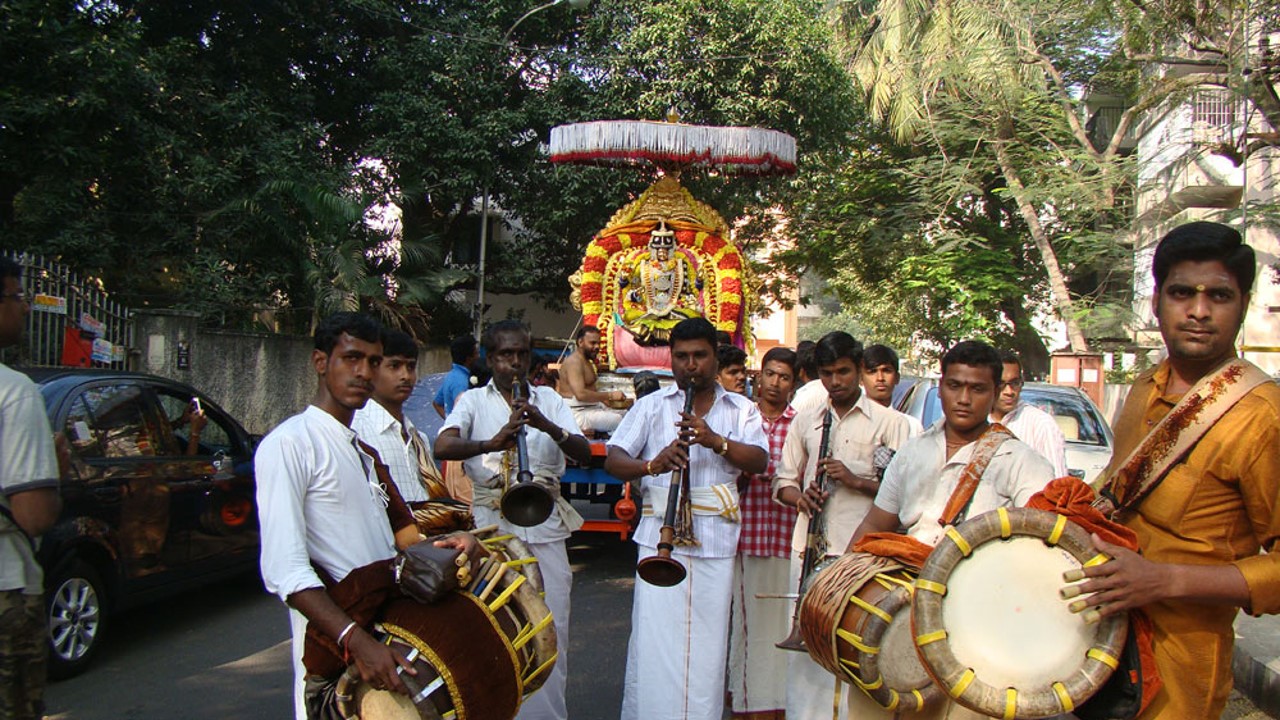
Nādḥasvaram is synonymous with the temple music in South India. The Shiva and Vishnu temples are equally popular in playing nādḥasvaram. Several temples with historical significance play nādḥasvaram during the pooja, homa and abhishekam time. One can see perfect coordination between the priest and the nādḥasvaram artiste during the daily rituals in the temple. Temples built during recent times seem to ignore this tradition. Nādḥasvaram accompanied by Tavil are considered essential for temple worship.
Nādḥasvaram musicians typically hail from a particular Hindu community. A few come from Muslim families. Their contribution to the Hindu temple music is significant.
A unique type of nādḥasvaram music called mallari, is played during the daily temple ritual. The Agama shastras call it mallara, and perhaps mallari is a twisted version of mallara.
Mallari comes in various forms. ‘Theertha’ mallari is played when abhisheka is performed on the deity. ‘Theertha mallari’ is also played when water is brought for abhisheka from the river or the temple tank. ‘Thaligai mallari’ is played when the food for neyvethiam is taken from the temple kitchen to the deity. There is also a ‘mudhal’ or first mallari played in the beginning followed by ‘periya’ or big mallari.
In those days, people who lived in the vicinity of a temple knew what was happening inside the temple just by listening to the mallari. Their knowledge of music was commendable.
‘Ther mallari’ is played when the utsava murthy is taken out of the temple on a procession. The utsava murthy is decorated with choicest jewels and garlands as it passes through the streets on a decorated chariot.
When ‘ther mallari’ is heard, people would know of the temple deity’s procession approaching their street. They either stepped out of their home or peeped through the window to have a glimpse of the deity. The deity graciously arrived at the doorstep of those who were unable visit the temple.
Lately, devotional and cinema music have replaced nādḥasvaram in the temples. Nādḥasvaram musicians are a neglected lot. Number of them are struggling. They earn their lively hood by performing primarily at marriages and functions outside the temple.
Deepavali is an occasion to remember the Nādḥasvaram tradition. Deepavali is warmly welcomed with Nādḥasvaram music.
On this auspicious day, one should wake up early and begin their day with a warm sesame oil bath before sunrise. As per mythology, goddess Mahalaxmi is said to manifest in sesame oil and goddess Ganga in all the water sources. Hence it is auspicious to begin the Deepavali day with oil bath.
One should sit in comfortable posture on a wooden plank decorated with rangoli. The eldest member of the family or lady of the household applies sesame oil on the heads of family members.
The sesame oil heated with black pepper seeds and ajwain is applied first on top of the head. Later the oil is applied all over the body. A haarathi is prepared by using water, lime, turmeric and kumkumam. The elder performs the haarathi on the family members who are adorned with sesame oil. The sesame oil represents goddess lakshmi. The goddess is thus welcomed on this auspicious day of Deepavali.
The oil ritual is followed by hot water bathing. The water is worshipped as goddess Ganga. Goddess Ganga descended from the heavens. The bath on this day is auspicious and is called “Ganga Snanam”. This is equivalent to taking a dip in the Ganga river. Pleasantries are exchanged between family members, relatives and friends. On this Deepavali day, a person is greeted by asking ‘Ganga snanam aacha?’ or ‘Did you complete the holy Ganga bath’?
One should not forget to play ‘theertha malari’ in the background during the entire oil and bathing rituals on this day. It is an opportunity to recognise the presence of goddesses Lakshmi in our lives . The nādḥasvaram music adds to the divinity.
Let this Deepavali bring celebration in our life.
 baladrishti